

We’ve had a number of graduates move on to really exciting and interesting positions over the years and we thought it might be nice to catch up with some of them to see where they are and what they’re doing. Today we’re talking to Bethan, one of our recent graduates. Bethan studied in Durham on the course in 2015 and went on to complete a placement at Glasgow Museums in 2016.
Where are you working right now?
I’m working at the National Museums Scotland Collections Centre in Edinburgh.
What are some of your responsibilities?
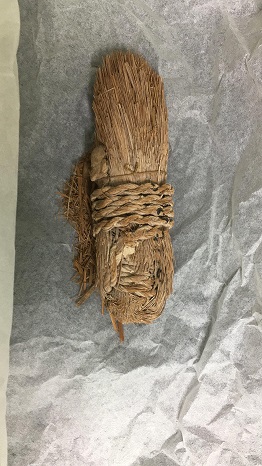
paint brush
The objects I’m working on are mainly from Ancient Egypt and East Asia as part of a major Heritage Lottery funded project to redisplay the collections in new galleries at the National Museum in Edinburgh. My main responsibilities are helping to ensure over a 1000 objects are conserved and display ready for the new galleries by autumn 2018, ensuring the high levels of health and safely are maintained at the NMS, and assisting with the conservation and condition assessments of other exhibition and tour objects and object loans as required, including objects from Scotland’s Early Silver.
What have you been working on lately?
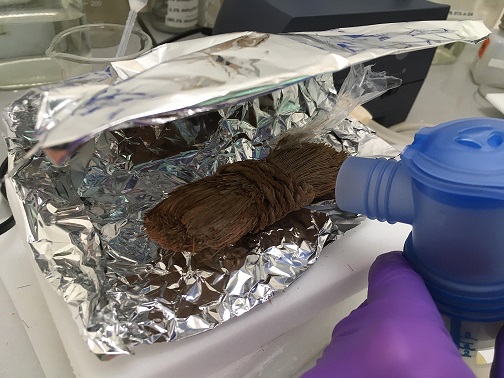
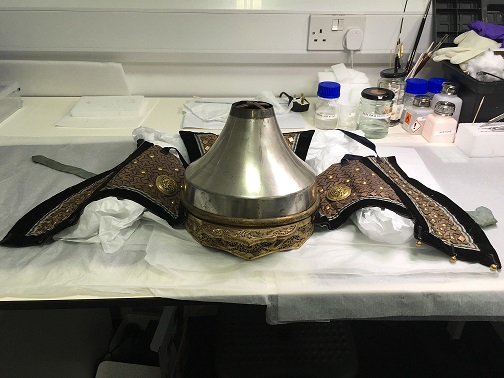
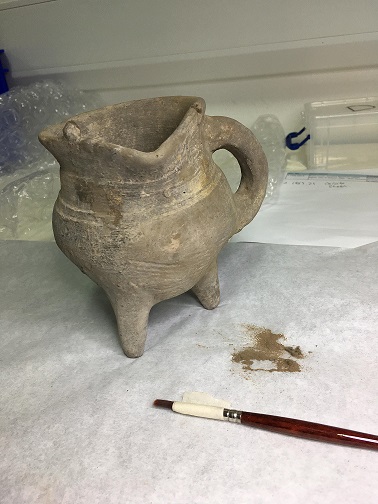
I’m currently working on a Chinese helmet and set of armour. It’s made from gilded and silvered copper-alloy and kingfisher feathers among other materials. And also a late 19th century Chinese, carved cinnabar lacquer, porcelain moon flask. I’ve just finished working on consolidating an Ancient Egyptian paint brush made from palm fibres from a tomb discovered in 1906, as well as a tomb offering of bread; painted limestone, alabaster and faience Shabtis; a late 19th century Chinese copper-alloy coin tree; and a medieval Chinese porcelain wine ewer. So it’s a wide range of materials and objects.
What is one of your favourite objects in the NMRN collections?
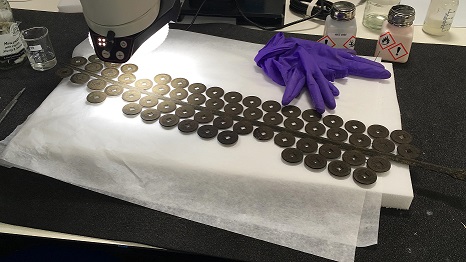
I love the Norrie’s Law hoard. It’s a hoard of early medieval silver, found in Fife during the 19th century. It’s one of the largest Pictish hoards ever found and dates from 500-600 AD. Lots of the objects are made from recycled late Roman silver, and some are decorated with Pictish symbols.
How did you become interested in conservation?
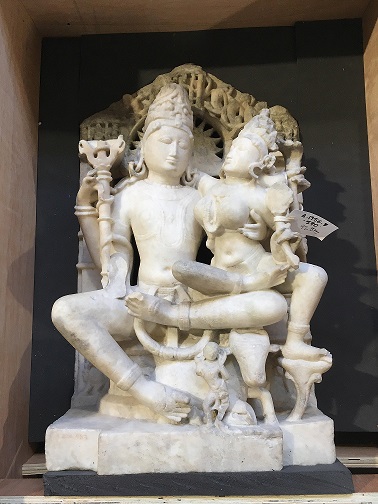
I’ve always loved history and archaeology. I studied archaeology and medieval history, and I used to work for the National Trust for Scotland. Working with archaeological artefacts and historic objects inspired me to get involved in the collections care side of heritage management, working with the Trust’s historic collections. I then discovered the conservation course at Durham and decided to retrain as a conservator.
How did the conservation course at Durham help you get where you are now?
The course at Durham gave me the qualifications I need to be a professional conservator, as well as the skills, knowledge and practical experience from the lab work and work placement.