

After a short break after exams, we started our exciting summer module: conservation practice. In this module, each of us is given four artefacts from the Oriental Museum and Beamish museum. We need to record, examine and treat them by ourselves with the consideration of the requirements of museums. The objects that we got are so interesting, because they all have mixed materials, mixed cultural background and mixed conditions. This sounds a bit challenging, but it also means that we could gain much more experience from the summer module.The four objects that I received are so different from each other.

The first object is a bronze (Copper-Lead) dagger-axe from the Oriental Museum.
This dagger-axe (戈, Ge) is an object specially made for a funeral because it is extremely thin and light. The dagger-axe has a curved handle (内, Nei). The handle is of a bird shape and has relief patterns or inscriptions on one side. It is broken in three sections. The surface has a patina and also evidence of dust and dirt. There are also traces of a previous repair: using paper and adhesive to wrap around the breakage and keep the two sections together. The major conservation concern about this object is how clean the object should be.

The second object is a badly broken ceramic from Beamish Museum.
The ceramic is broken into several pieces. There are transfer-painted patterns on the glaze and on the bottom, there is a stamped word “ENGLAND”, which indicates that this object was made in England.
There are physical deteriorations, dirt and staining on this ceramic. Crazing is all over the ceramic and stained badly in some areas. The transfer printings are scratched and abraded. A great amount of dirt is trapped by the residue on the surface. Moreover, some pieces are missing. The major problem for this object is how to protect the transfer printing while removing stains on the surface and between crazing. Consolidation may be needed, and a milder cleaning method should be applied.
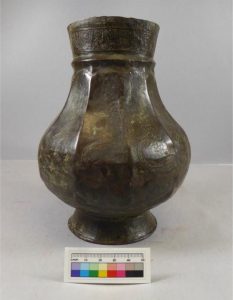
The third object is an Islamic style brass jug from the Oriental Museum. The jug is inlayed with copper and silver and decorated with calligraphy and animal figures. The handle is missing, and holes are filled with solder. There are several cracks in different areas. The top rim is slightly deformed. Also, there are creamy white deposits on the interior surface.
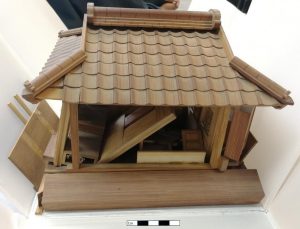
The last object is quite complex. It is a Japanese doll house with three seated dolls. The major structure is made of bamboo. The square house has a small covered veranda running around the outside and small external, hinged storage cupboards. The house is in very poor condition with many of the internal partitions and furniture broken or out of place. Many pieces are distorted due to RH and temperature changes and bad repairs.

The most interesting part is that, during the examination, evidence of insects were found on two pieces. Therefore, after contacting the museum, the whole object has been sealed with polythene film and put into the freezer for two weeks.

Thorough examination and recording are key steps before any treatment. Also, treatments should be designed carefully for each individual object according to their unique problems. We should be fully aware of the needs of the object and the requirements of the clients (curators), and then make the right decision for the object. Sometimes, doing nothing is the best option.
Now, further research and examination are still carrying on in the lab. Everyone is busy working on the treatment proposals for their fabulous objects, which will be agreed with the museums. Hopefully everything will be fine and I can’t wait to see the outcome of our work at the end of the summer!