

Object
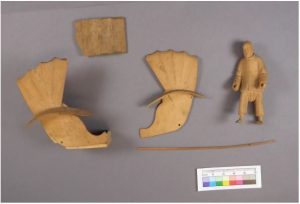
A wooden rickshaw model from the Oriental Museum collections. This object was acquired by the Oriental Museum within a larger collection of similarly crafted models. The models are largely figural and depict figurines in a variety of scenes such as execution, drug use and agricultural tasks.

The models were created to be sold to foreign families as ‘educational souvenirs’. Souvenirs are portable objects intended to visually represent society’s cultural heritage, often modified to meet the expectations of the market. The controversy carried by this model is not inherently the image of the man pulling the rickshaw but rather it is the construction and curation of this particular image (and others mentioned above) by wealthy Europeans attempting to represent China to the wider world.
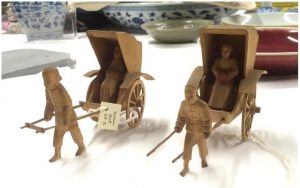
Overall, the value this object carries is its ability to communicate the image of a figure pulling a rickshaw, and in the condition the model arrived to the laboratory this essence was lost.
Condition
- The model arrived completely fragmented with a number of components missing such as the wheels, axle, handle and a small part of the rickshaw seat
- The model was lightly soiled with dust and dirt
- The small iron pins had corroded
- Evidence of insect eggs in crevices of the model.
Conservation

Following the discovery of small insect eggs on the model, this model and others stored with it were collected and packaged in a sealed finds bag, cushioned with acid-free tissue and placed inside a larger polythene bag which was thoroughly and extensively covered with packaging tape to prevent any pests escaping or entering. This was then placed inside a freezer (-20°C) for 2 weeks, where the temperature is sufficiently low to kill all insects and eggs.
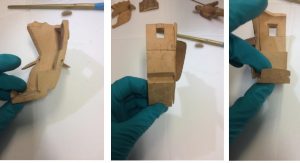
Removal of surface dirt began with cleaning using a Museum Vac vacuum on low suction. Further cleaning was undertaken using a smoke sponge to remove the more ingrained surface dirt. This method of cleaning was very gentle on the surface, left behind no residue and did not lift away pigmentation from the roof. There are small pencil marks on the surface which are associated with construction and a trader’s mark- these have been left in place as they are informative and could benefit future research.

The small iron pins which had corroded were treated under a microscope using a cocktail stick as it lowered the risk of damage to the wood in which the pins will be placed into and reduced the risk of the wood being scratched. In order to create a barrier between the iron pins and the wood, and also to lower the rate of corrosion in the future, microcrystalline renaissance wax was applied using a cotton swab under a microscope.

The handle and small area of loss in the rickshaw seat can be easily replicated from the current intact components of the object. The wheels are arguably the most important component of the piece, giving the model the immediately recognisable appearance of a rickshaw. Reconstruction of the wheels is more problematic given that no evidence remains of their appearance and size, therefore necessitating an element of speculation. Fortunately, it was possible to devise a number of potential ratios for the size of the wheels using the comparative models as a guide.
From the visual appearance of the plastazote discs and from the height they lifted the rickshaw from the ground, the 5cm diameter seemed to be the most convincing. The space between the wheel and the wheel arch was reasonable and similar to the other models; also the rickshaw stands at a height which is compatible with the height of the figure.
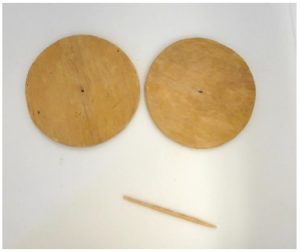
It was decided that the reconstructed wheels would not have spokes and would be composed of a single disc. The reasons are that:
- It is difficult to deduce the number of spokes the wheels would have had (or perhaps even if they would have had spokes).
- Including spokes would require a level of wood working skill beyond my abilities and a disc construction could be created to a high quality.
- Utilising a disc ensured that the reconstructed wheels are easily differnentiated from the original wheels of the other models.
- Wheels without spokes (discs) will effectively support the model.
Overall, disc wheels without spokes would remain instantly recognisable as wheels and this was the largest priority, conforming with the main goal of this conservation.
Balsa wood was the most appropriate material to use for reconstruction due to its ease of working, light weight, compressibility and also given that it is wood it will behave similarly to the original wood- this is supported by the frequent utilisation of wood to gap-fill furniture by furniture conservators.
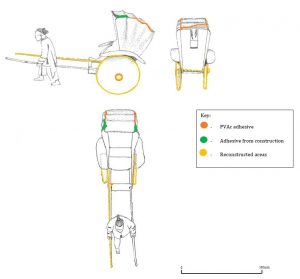
The handle and axle were also made from wood for the same reasons described above. The handle was constructed from a thin piece of dowel which was sanded and cut to the correct dimensions. The axle was constructed from a cocktail stick where the ends where sanded to fit into the holes on the side of the rickshaw seat. It was not possible to shape the entire length of the cocktail stick to the required size as previous axles were too thin and would easily break under the weight of the rickshaw.
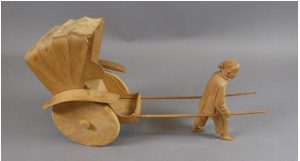
Using Liquitex heavy body acrylic paints it was possible to achieve a colour similar to the original wood. The mixture was watered down to create a wash and then painted onto the fills. To achieve an uneven surface similar to the original, a piece of plastazote was used like a sponge to dab darker paint onto the surface.
The model was then reconstructed using neutral pH adhesive, applied to the joins using a paintbrush.