

In October 2019 I began my placement at the Science and Industry Museum in Manchester and the past few months have been a brilliant opportunity to gain first-hand experience of what the role of a conservator entails at a national museum.
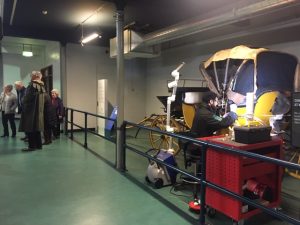
The Science and Industry Museum is based on the site of Liverpool Road station, built in 1830 as the first passenger railway station in the world. Its collections are focused on scientific, technological and industrial objects that explore Manchester’s achievements in these fields. These range from small microscope slides, right up to steam engines, early computers, working textile looms and even aircraft!
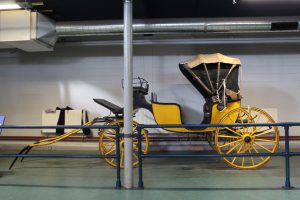
The first major project I’ve been given as part of my placement is the conservation of a horse-drawn ‘sociable’ carriage – sociable as four passengers could face one another whilst a coach driver drove the carriage. Built in 1895, it was constructed by the award-winning Manchester carriage builders Joseph Cockshot & Co and was donated to the museum in 2000 from a historic property. Prior to it entering into the museum’s collection, it was in poor condition and has had two previous treatments to improve the carriage’s stability.

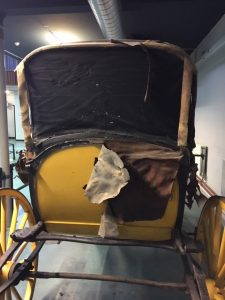
The importance of this object is that what remains of the carriage’s upholstery is original to its late Victorian construction, which is rare as upholstery and coverings of transport objects were often replaced during their working life. My project is to improve the condition of the carriage’s leather canopy and other parts of the carriage to ensure they survive for as long as possible.
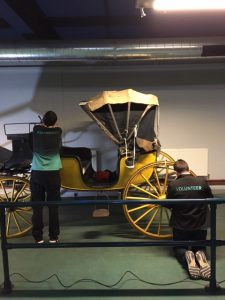
This project has involved a process of cleaning and stabilisation, but given the size and scale of the object it has thrown up some interesting problems. Normally when an object is conserved it would be taken to a conservation laboratory to be treated. However, the carriage is currently on display and is not only too large to fit in the lab but there are several aeroplanes and a main road in the way! It was decided that it would be much more feasible instead to conserve the carriage in-situ.

The process of treating the carriage where it is currently on display has meant I’ve had to essentially bring the lab to the object and has been a great exercise in organisation and time management; setting up all equipment and solvents I need for the day and ensuring they’re packed away safely before I leave.
Working in this space has also meant I’ve had numerous positive interactions with visitors, who have been very interested in the work I’m doing and I’ve used this as a good opportunity to engage members of the public with the importance of conservation and the work of conservators. Additionally, I’ve been able to gain some experience of volunteer management; supervising two volunteers who’ve helped me clean some of the surfaces of the carriage. The help of volunteers have been really useful with an object of this size as every task takes so much longer than with a smaller object – even surface cleaning with a vacuum cleaner and a brush took three days!
So far the carriage has been thoroughly researched, with all of its surfaces cleaned both mechanically and with solvents where appropriate. The surface of the canopy has been consolidated and I’m now beginning the process of reshaping the distorted leather with the intention of adhering the splits, reattaching missing fragments and eventually reattaching it to the frame of the canopy. This will both improve its stability but also help visitors to interpret that the leather is part of a canopy.

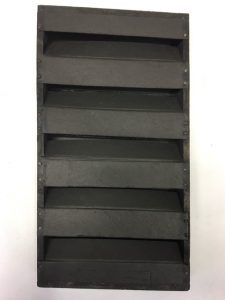
This has been a very useful experience in how conservators have to manage the competing demands of their workload. I’ve been required to balance the requirements of this treatment with other projects I’ve been involved with. These have included the treatment of a World War Two black-out ventilator, monitoring for insect pests and condition surveying objects in preparation for decanting a large gallery space.
I’ve really enjoyed my time at the museum so far and I’m excited about what the coming year will bring!
Mark