

Object
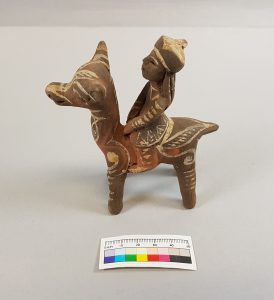
A small, ceramic figurine from the Oriental Museum Collections.
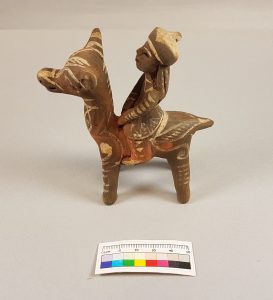
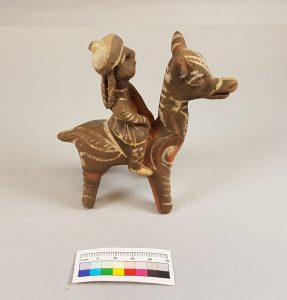
The object is a small figurine of a humanoid figure riding a four legged animal. The rider is wearing a round hat with a pointed tip. The figure is clothed in undistinctive attire that flares out over its thighs and the animal’s back, possibly a long jacket or a skirt. There are five braids of hair descending from the hat. The figure’s face is simple and tilted upwards.
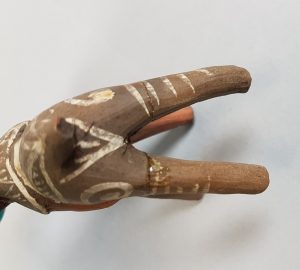
The animal has four legs spread wide with a proportionally sized body and head. It also has a long neck, a short tail, large triangular ears, a long muzzle and a slightly open mouth.
The object has been painted dark brown, however, the red colour of the undecorated ceramic beneath is showing in some places. An off white paint has been used to add details and decoration.
Condition
- Evidence of dust and dirt on the surface
- Evidence of past repairs
- Some past repairs appear misaligned
- Signs of excess adhesive on the ceramic.
Conservation
Initially the figurine was treated by brushing the dust and dirt from the surface using a soft bristled brush; a Museum Vac was also used in order to catch and remove the surface dust and dirt from the ceramic figurine. As the existing joins were misaligned and excess adhesive had spilled out of the joins and onto the ceamic surface, the decision was made to remove them. Before this could occur a small sample of the old adhesive was removed and tested using ftir analysis to determine the type of adhesive that had been used. By studying comparative spectra, the old adhesive appeared to be a type of cellulose nitrate.
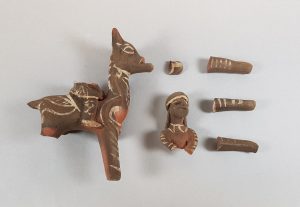
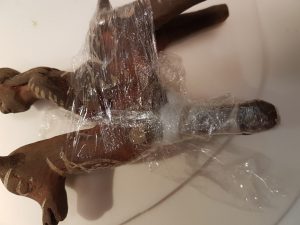
Tests were performed on samples of the old adhesive to see which would be the least harmful solvent required to take down the joins. After extensive testing, ethanol was found to be sufficiently effective at dismantling the ceramic figurine safely. As the white pigment on the surface of the figurine was possibly susceptible to all solvents, care was taken to avoid the ethanol coming into contact with it. As such, the areas around the joins were wrapped which would act as a barrier against the ethanol.
Ethanol was applied to the joins using a suitable poultice and were left for approximately 30 minutes in order to allow sufficient time for the solvent to soften the adhesive. Once the past repairs had been taken down, the edges of the joins were cleaned using cotton wool swabs with ethanol in order to remove the remaining old adhesive.
Before the joins were readhered, a suitable adhesive needed to be chosen. The new adhesive would ideally dry water white, be long term stable, strong enough to hold the join, but not stronger than the original material, and would have some degree of flexibility. After a number of adhesives were tested, the decision was made to use Paraloid B72 adhesive, as this is commonly used on ceramics and had the majority of the desired properties.
The pieces of the ceramic figurine were then aligned correctly and adhered using Paraloid B72 adhesive. Small sections of an appropriate tape were applied across the joins in order to hold the adhering sections together and they were supported in a sand tray until the adhesive had fully cured. Any excess adhesive which had overspilled during the curing process was removed using cotton wool swabs with ethanol.