

Object
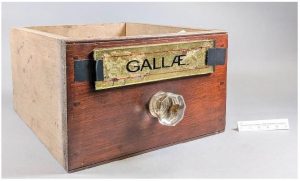
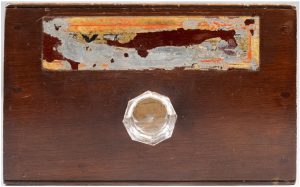
A small drawer made from oak wood with a glass knob handle. The object is part of the chemist’s shop exhibit at Beamish living history museum. There is a glass label on the front of the drawer with word ‘GALLÆ’ painted on and the background appears to be bronze leaf ‘gilding’. There appears to be evidence of earlier paint and true gilding beneath the label.
Condition
- The glass label is missing areas of decoration and is being held on to the drawer using electrical tape.
- There is evidence of mould on the interior of the drawer.
- Excess animal glue is present around the interior joins of the drawer.
- Signs of dust and dirt on interior and exterior surfaces.
- There appears to be modern ‘gilding’ residue on the glass knob.
- Evidence that the drawer has slightly warped around the joins.
Conservation
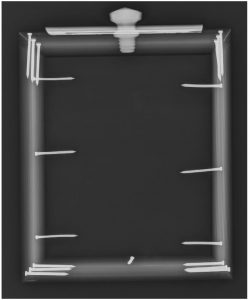
An initial x-ray was taken as a means to view the construction of the drawer, to understand why the warping may have occurred and to determine whether the nails had corroded within the wood or not.
The mould found on the interior of the drawer was removed and treated before further treatment was undertaken. Initially the mould was removed with a vacuum equipped with HEPA filter. The area with mould growth was then treated using a solution of ethanol and water in order to kill any remaining mould spores. Following this initial treatment the remainder of the drawer was vacuumed, ensuring a fresh bag was used to avoid contamination.
Following this, dry cleaning tests were undertaken on the bare wood of the drawer interior on examining the results Akapad was chosen to complete dry cleaning of the drawer. This material removed the modern dust and dirt but didn’t remove any historic staining, which was important to retain as it provided information about the drawers history and use.
The excess animal glue located around the interior joins was removed to help prevent regrowth of mould as it was suspected that the animal glue may have contributed to the initial growth of mould. The areas of thicker overspill were softened using deionised water so they could then be removed mechanically as much as possible. The final remnants were then removed using cotton wool swabs with deionised water. After the aminal glue had been removed the area was again swabbed using ethanol to kill any potential mould spores that might have been dislodged.
The environment in the chemist’s shop exhibit is uncontrollable; therefore RH and temperature parameters are impractical as ways to prevent mould. Since the mould had only been observed on thickest areas of overspill, presumably as it used the organic animal glue as food source, removal of extra adhesive should theoretically remove the food source and prevent mould regrowth.
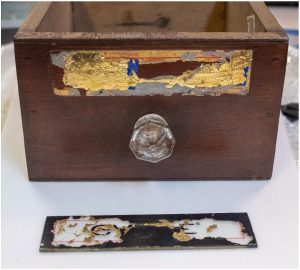
The residue on the glass knob was cleaned using deionised water with a few drops of Synperonic A7, this successfully removed the residue without damaging the glass. The glass knob was then swabbed with pure deionised water before being dried using a soft microfibre cloth. Following this the decision was made to remove the glass plate in order to assess its overall condition and also to assess a more appropriate was to attach it to the front of the drawer. The electrical tape was gently removed and left no adhesive residue behind. Once the glass label was removed an earlier layer of gilding was revealed on the surface of the wooden drawer.
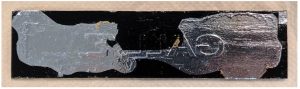
On removal of the glass label the full condition could be assessed. It was discovered that there had been some earlier repairs to the label which included blue electrical tape and fibreglass tape. The decision was made to fully remove these past repairs as they would make reattaching the glass plate difficult. They were removed using mechanical methods and on doing so the bronze leaf ‘gilding’ experienced some losses. Following removal of the glass label, the front of the drawer was cleaned with a handheld eraser to remove the surface dirt located underneath the label and leave the front with a more cohesive appearance.
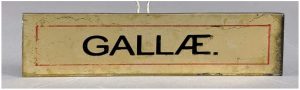
Testing was undertaken to determine the best adhesives to use for re-gilding the glass label and re-adhering the label to the drawer front. The main concern for the museum was adhesive strength in order to ensure the drawer could be used without the label falling off; however, it was crucial to ensure some degree of reversibility and protection of the original gilding/paint. To encourage the ability to remove the label with minimal damage in the future, the adhesive used for gilding and coating needed to have different (even just slightly different) solubility than the adhesive used to readhere the label to the drawer. The adhesive solution used also needed to not dissolve any of the paint or original gilding in the process.
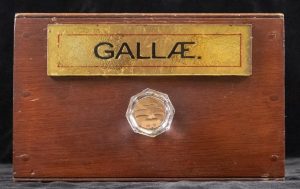
After testing, the glass label was re-gilded using Primal B60A with a few drops of deionised water and synthetic gold-look gilding. It was re-gilded in two large main sections and then several smaller individual pieces. The area was covered with a thin layer of Primal B60A, then crumpled acid free tissue was put behind the gilding to help imitate the remaining glass gilding surface texture while drying. The glass label was then placed between two layers of plastazote and clamped gently to ensure even and flat adherence. Once completed, the back of the re-gilded label was given 2 coats of Primal B60A with a few drops of deionised water added for consistency to help seal it. The original paint/gilding on the drawer front was given two coats of this same solution to help protect and preserve it in case of future study.
Once fully dry, the label was adhered to the drawer front using HMG Paraloid B72 with a few drops of acetone where necessary to reduce viscosity and drying time. The label was matched to cover the traces of original gilding/paint and gently clamped to ensure good adhesion, using plastazote to prevent the clamps damaging the wood of the drawer. Overspill was cleaned gently with wooden tools in a few places.