

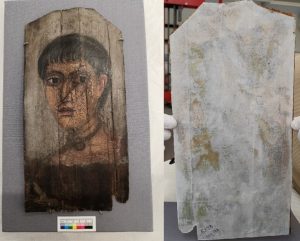
On 6th February, Golden Mummies of Egypt exhibition was launched in Buffalo, USA. It is the first international exhibition tour that Manchester Museum has ever had. The exhibition delivers highlights of Manchester Museum’s Egyptian collection and insights of research on the collection.

Before the exhibition, the conservation team at Manchester Museum had to do all the preparation work for objects in the exhibition, including condition checking, conservation, packing and mount making. Abby, the preventive conservator, was working on mount design with Bob, the museum technician. Jen and Irit were working on object conservation and condition checking. Sam was not just working on object conservation, but also worked on schedule and management, including contacting people from all sorts of places who would be involved in the transportation of the objects. Not just conservators, all staff from the collection team were helping out. In the meantime, there were other projects happening in the lab. So, it made everyone in the lab busy before Christmas.
I was lucky to be involved in such a big project. My main task was taking care of 11 mummy portraits within the collection. Meanwhile, Jack Snape, a wall painting conservator, was helping, as a volunteer, to do condition checks of the 11 portraits.
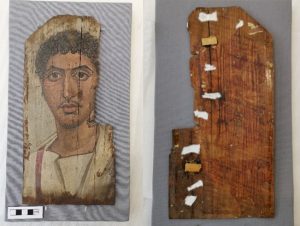
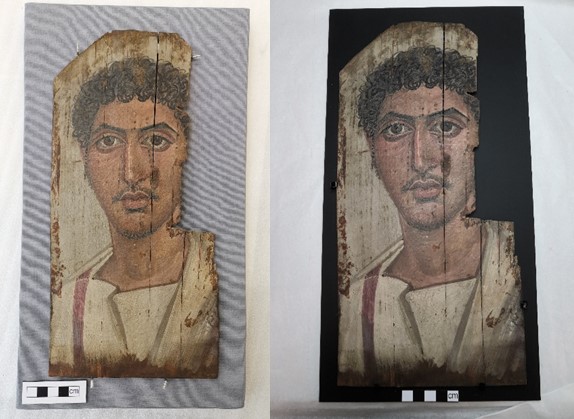
The portraits are all from Hawara, Farum, Egypt, and date from 98 to 195 AD. These mummy portraits are painted in encaustic hot wax technique on a thin wooden panel. They have all been treated previously. Some of the portraits were adhered to a thicker wood panel, while others were reinforced by tissue strips or wax with fabric. Warped portraits were re-constructed by adhering on nylon net.
As the portraits all had different types of deterioration associated with them, they were treated individually and all treatments were specific to that objects deterioration issues:
- Basic surface cleaning was applied to mummy portraits that were fragile but stable

- Mummy portraits that had a flaking surface would be at risk during traveling. Therefore, consolidation was applied to these kinds of portraits to make sure they would be safe during traveling
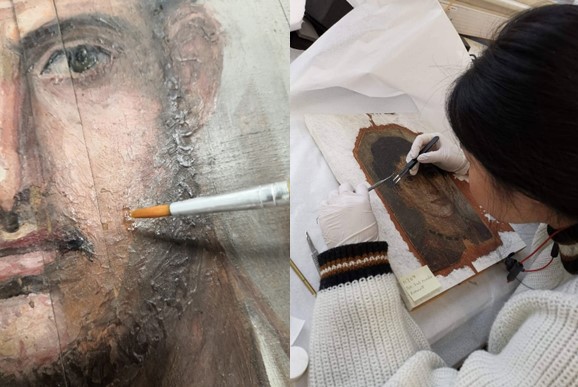
- Areas of cracking were secured using Japanese tissue paper
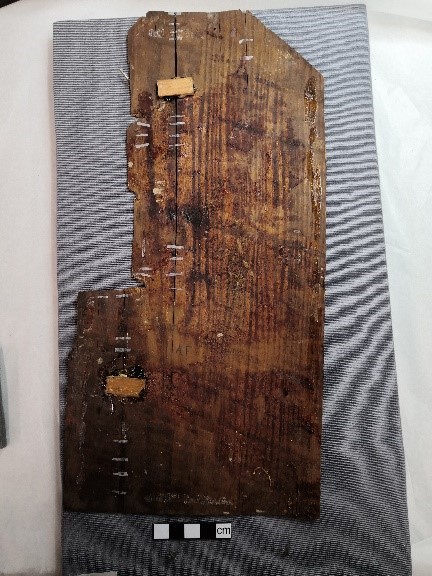
To fit in the style of the new exhibition, new mounts were made for each portrait:
- For portraits which were secured on a wood panel, the wood panels were covered with cardboard and black fabric to match the main colour of the exhibition. Zoe Lanceley, a freelance textile conservator, developed the mount for the portraits and taught me how to make them.

- For portraits on their own, a black Perspex panel was made for each of them, with four small J-pegs to secure the portrait. Moreover, they would travel on their original mounts with a piece of cardboard covered with fabric and plastazote
Packing
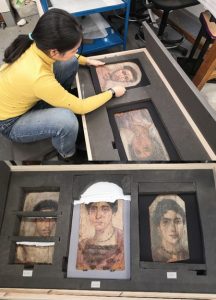
Packing is a really important step for preparing a touring exhibition. Besides travelling, objects will be packed and unpacked several times during the tour. Therefore, it is vital to make sure the packing is safe and easy to repack.
Packing started before Christmas and continued after the Christmas break. All the portraits were packed in one crate with 6 trays. Plastazote was cut into the shape of each portraits. Japanese tissue paper was put under wrapped portraits to give more support.
To prevent scratching, Teflon film (polytetrafluoroethylene film) was wrapped around the portraits. Teflon film is very smooth, like skin, so it is suitable to protect vulnerable surface like mummy portraits.
After packing one tray, two labels were adhered on the top and side of the tray. Then, all the trays were loaded in one crate.
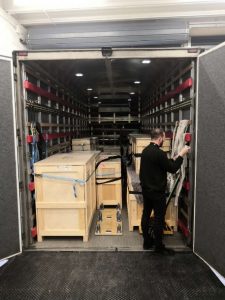
After everything was packed, the crates were transferred to trucks, ready to be shipped to Heathrow Airport, and then Buffalo.
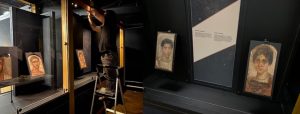
After another week of hard work, Sam, Bob and the team from Buffalo Museum of Science finished installing the whole exhibition. The outcome is fabulous. Everyone is astonished by the final look of the exhibition set out.
From this busy period, I have learnt many things. Not just conservation techniques, but also how people in the museum work together to set up a new exhibition tour.
Liuyi