

Object
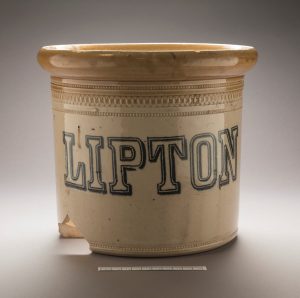
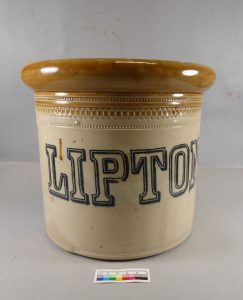
A beige coloured Edwardian dairy butter crock (earthenware) with a circular body that widens at the rim, and is covered in a clear glaze. The rim and top of the body of the ceramic has light brown paint beneath the glaze. At the top of the ceramic there are three lines of stamped design that circle the object. On the exterior, the text “LIPTON” is painted in navy blue beneath the glaze in large, block lettering. Also on the exterior in much smaller text, the words “12 lb” is stamped into the ceramic body.
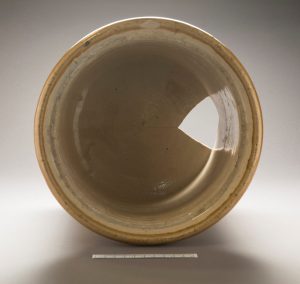
The ceramic has several manufacturing errors making it appear to be poorly made (low quality). There are areas of dripping glaze and paint that have dried out of place and black impurities evident throughout the fabric of the ceramic.
Condition
- The ceramic has evidence of museum dust/dirt on the surface
- The interior of the ceramic has a significant amount of white concretions on the surface
- There are areas of darker surface dirt across the interior
- There are two areas along the interior rim that have suffered surface material loss
- There is a large fracture on the base, which also extends up the body of the ceramic.
Conservation

The object was initially cleaned using cotton wool swabs with a suitable solvent for ceramics in order to remove the initial museum dust and dirt. The white concretions could not be removed with swabbing so a poultice of the same solvent was attempted in an inconspicuous area, but also had no effect on the concretions.
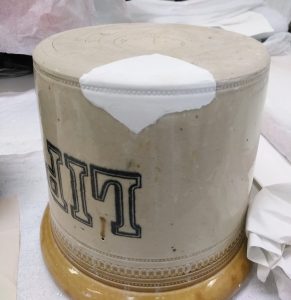
Solvent gels were then tested for removal of the concretions: 4% Laponite in deionised water with several drops of Synperonic A-7, 4% Agarose in deionised water with several drops Synperonic A-7. Both were applied in gel state and were left on the concretions for 3 hour intervals, none of which had an effect.
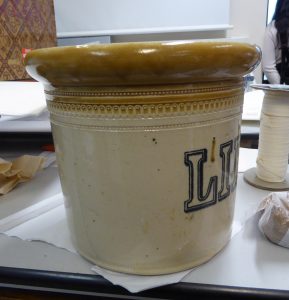
It was decided to place the ceramic in a sodium hexametaphosphate solution to attempt removal of the concretions. The ceramic was left in the solution overnight before placing in a bath of deionised water for a day. The sodium hexametaphosphate was also unsuccessful at removal of the concretions, so it was decided to let them remain on the ceramic as no method could be found that was successful at removing them.
The hairline fractures radiating from the area of loss were stabilised with an appropriate consolidant, which were applied to the cracks using a needle and syringe. This process allowed the cracks to be filled with a stable material, which would help to prevent them from deteriorating.
A fill was made to the area of loss in the base by moulding a piece of dental wax to one side, and filling the loss from the other side using a fill material of 10% glass microballoons in Plaster of Paris. This material would be strong and stable and would react to the environment in a similar way to the original object. Fills were not made for the areas of missing surface material on the rims as these areas were structurally sound.
Finally the fill area was sanded to a smooth surface, colour matched to the original ceramic using acrylic paints and then coated using a specific ceramic glaze to mimic the original object.