

Object

We’ve had a short break from blogging as we have no students over September and we’re usually spending a lot of time marking their wonderful portfolios. The start of October has also been quite hectic as we’ve welcomed our new intake of conservation students and I’m sure you’ll see some blogs from them in the near future.
Over the summer we had an interesting wooden donations box from Beamish museum, which required conservation work. This wooden donations box comprised of 14 slats each with grooves cut into them for a friction fit. Two tall vertical slats and one of the shorter ones had been broken in the past. These had been crudely re-adhered at some point in its history.

The shorter slat had suffered some loss where the break was and the failed adhesive indicated that it was adhered in the inverse orientation. The front facing slats have wording on the surface, indicating the original function and use of the object; one slat says, ‘Little Hilda’s Box’ and a second says, ‘For the childrens hospital’. From microscopic analysis the wood appears to be mahogany, specifically Honduras mahogany.
Condition
- Evidence of surface dirt on the wood.
- Three of the slats have been broken in the past.
- Evidence of past adhesive on the surface around the break edges.
- There appeared to be old sellotape on the surface.
- Some evidence of possible staining.
Conservation

The old adhesive was tested for solubility and as it was found to be insolube in all available solvents, it was determined that it was likely a degraded epoxy resin. The old joins were cleaned up by mechanical means under a microscope in order to avoid damaging the wood. One of the old repairs was left in place as the join was adequate and appeared relatively stable. The old sellotape was removed using an appropriate solvent that dissolved the adhesive but didn’t damage the wood.
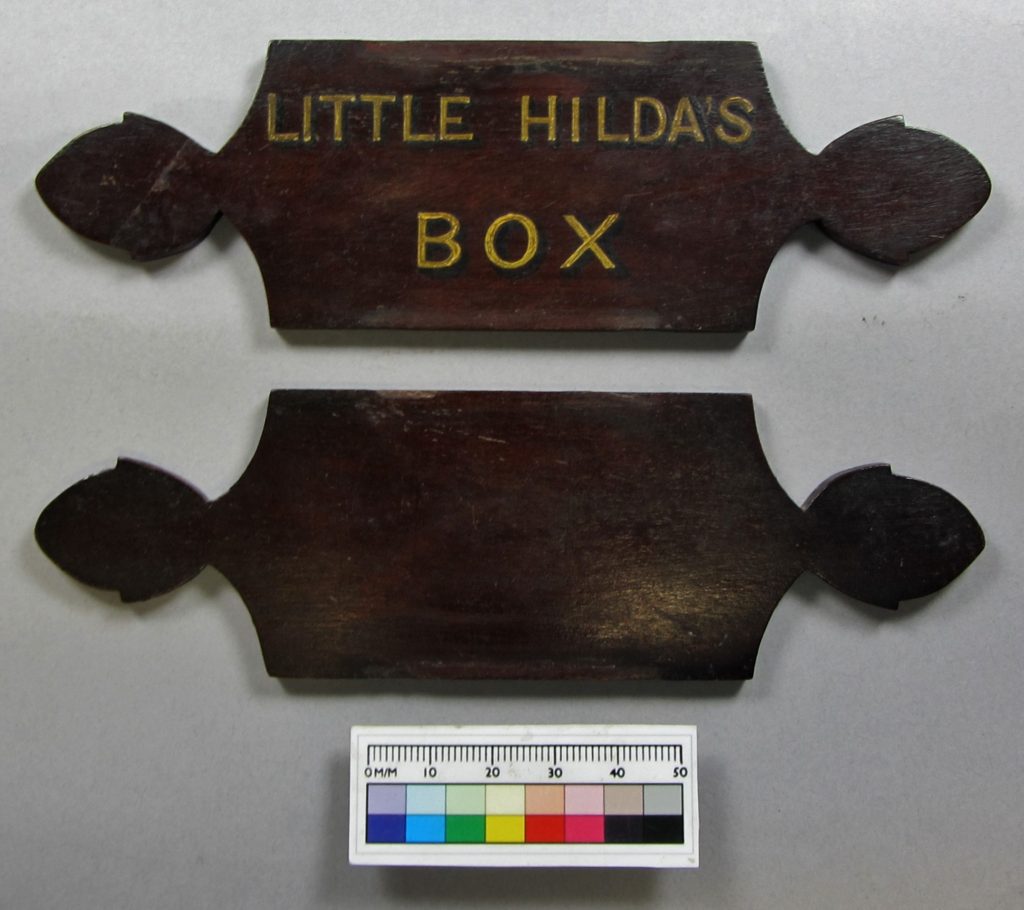
After testing dry cleaning methods, the surface dirt was removed from all parts of the object using an appropriate dry cleaning material. The remaining surface staining unfortunately could not be removed by either dry or wet cleaning and so it was decided to leave it in place to avoid potentially damaging the object. The surface shine of the donations box was restored by polishing with a microfibre cloth, using a suitable coating; this helped to create a more uniform colouring and surface.
The surfaces on the break edges were consolidated with an appropriate consolidant available and then the join was adhered using an acrylic copolymer, which has been found to be successful at adhering wooden objects. This was clamped together in order to achieve a strong join and avoid movement. All remaining gaps where the pieces were joined and adhered were filled and colour matched using Liberon waxes.
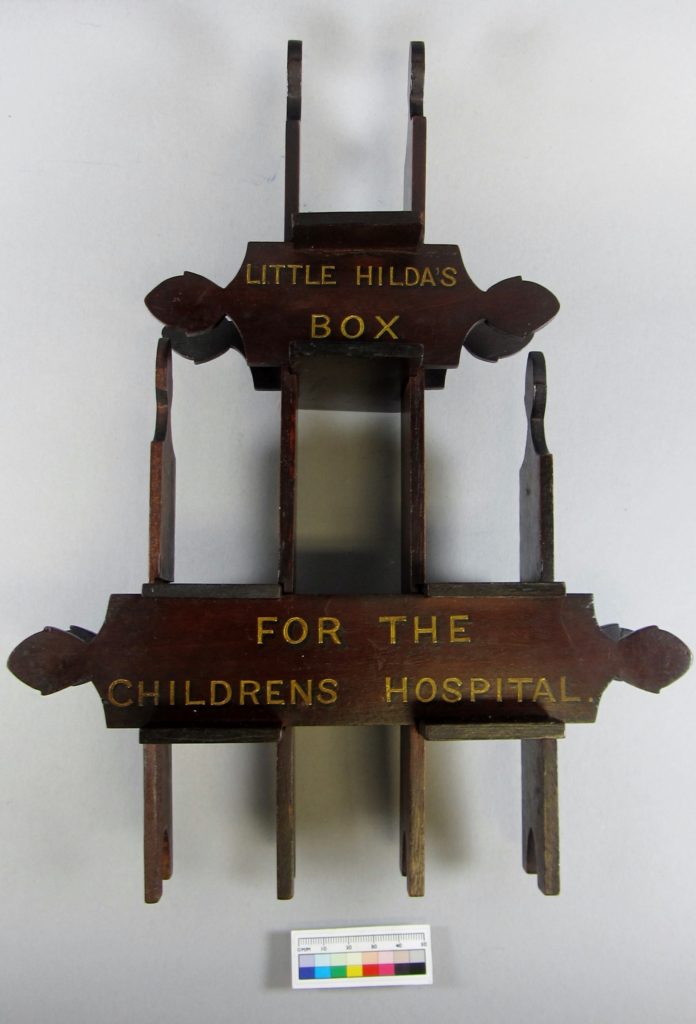
One of the slats had suffered both loss from the break and poor previous repair. A new base section was carved out of balsa wood and then stained to match the original section. The replicated fragment was consolidated using an appropriate consolidant and then the two pieces were adhered using the same method above.
Throughout the cleaning and repair procedures, any toning and soiling that could provide clues as to the original configuration were noted; using this information alongside the existing image, a well-fitting configuration was derived. Despite the good fit, the shrinkage of the pieces over time has left the joints loose. Plastazoate blocks were cut to fit the 3 coin compartments. The upper surface of each was painted brown with acrylic in order to minimise the obtrusiveness of the plastazoate. The model was reconstructed with these supports within to stabilize the structure and was packaged fully reconstructed in order to minimise the risk of pieces becoming disassociated with the whole object.